
A prominent physicist on TV once said that the problem with 'speculative science' is that is is almost always wrong. I, of course, immediately keyed in on the word, 'almost'. That means that speculative science is right, now and then. Well, that's good news. That means that wild speculation might lead to real scientific discoveries! Without all that nasty math, too! Well, on with the speculation:
The following is an alternative explanation to the 'extra' gravity we seem to observe in galaxies, currently attributed to 'dark matter'. Assume that there is a massive black hole at the center of all galaxies and that the black hole is constantly accreting matter. That seems reasonable in light of the massive amount of matter spit out by the billions of stars in the galaxy. Now, imagine an atom entering the tremendous gravity gradient near the event horizon of the black hole. The electrons will spend a portion of their time in a higher field when they are on the black hole side of their orbit due to the steep gravity gradient. When in that more intense gravity, they will experience increased time dilation and will seem to linger a bit longer on that side of the atom. In the extreme, right at the horizon, the electron will seem to "freeze" on the back side. The result is that the atoms will exhibit a charge felt by neighbors further out, and, therefore, the black hole will appear slightly positive to the rest of the galaxy. This effective positive charge will attract electrons from the ionized gas that fills the galaxy. Filaments of current will travel between nearby stars and the black hole and between stars further away. (Electrons will stream toward the center of the galaxy and positive ions will stream toward outer stars.) These current filaments will conduct the electric force much the same way a string of paper clips conduct a magnetic field much further than without the clips. The stars will be attracted to each other by a force that doesn't drop off as quickly as might be expected and which can be quite powerful despite the small charges involved due to the relative strength of the electric force to the gravitational force. When this flood of electrons reaches the black hole, they encounter a hidden surplus of electrons. The electric force being so much more powerful than gravity, these electrons are deflected along the event horizon and collide at the poles, spraying into space at right-angles to the disk of the galaxy. Meanwhile, positive ions are being repelled out of the galaxy along the plane of the disk. These positive ions and electrons are attracted to each other and bend around to form a lens-shaped halo of both ions and recombined atoms around the galaxy. The electrons stay near the poles, being attracted back down by the ring of positive charge around the galaxy but not pulled particularly hard in any direction. but the positive ions see a huge clump of negative charge above the pole and are highly attracted to it. That's why most of the "action" occurs near the poles, despite the greater mass of the ions.
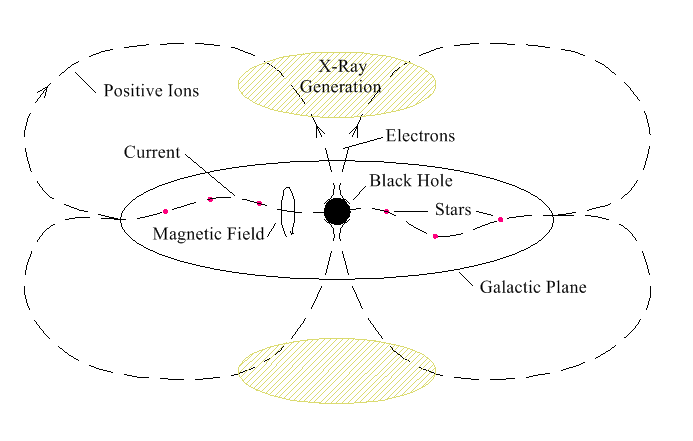
Here are some results:
The ion filaments conduct electric force, attracting the stars to the center of the galaxy, explaining the missing gravity. This force does not drop off by 1/r2 due to the flow of ions between stars. The charge is replaced by the continual matter accretion. Sparce galaxies will have less ion current and therefore less attractive force due to the resulting electric field. "Lightweight" galaxies will appear to have much less "dark matter."
The neutral atoms in the halo around the galaxy act as an ordinary lens, adding to Einstein's gravitational lens due to the mass of the galaxy.
Cosmic rays approaching the edge of the galaxy spend hundreds of thousands or even millions of years being accelerated by these electric fields due to the size of the galaxy, explaining the unusual energy these particles exhibit, especially near the edges where Earth is located. Essentially, we're in the target zone of a mammoth linear accelerator. Electric fields within the galaxy deflect and accelerate these particles so that they arrive from a variety of directions and with a spread in energy. Cosmic rays originating within the galaxy would tend to be confined to the disk of the galaxy and be accelerating in a generally outward direction, but with randomized paths due to the complex electric and magnetic fields within the galaxy. The relative lack of electron cosmic rays isn't surprising in this scenario; near the black hole, where the acceleration is more linear, they are going the wrong direction. Whereas, the positive ions get a swift kick in the pants towards the stars, and, as they travel along the filaments of current, they experience more acceleration. One might predict lots of electron cosmic rays for planets more near the center of the galaxy.
Objects (like spacecraft) leaving the solar system will be exposed to the electric field and will have a small charge induced across their surface. This induced charge will cause a very slight force that will slightly change the velocity. Near a star, the copious ions will shield the galactic electric field. Voyager exhibited unexpected acceleration when it left the solar system. I predict that the force vector would be the sum of vectors pointing toward nearby stars closer to the center of the galaxy.
The recombining ions would generate photons of energy proportional to their energy. That might explain this: http://www.telegraph.co.uk/science/space/8125127/Giant-space-bubbles-baffle-astronomers.html X-rays would be expected by such high-velocity marriages. (If that link goes dead, the article basically shows halos of x-ray generation above and below the poles of the galaxy.)
I propose time dilation as the source of the polarization of the black hole but other factors could be more important, perhaps something as simple as higher electron mobility in the accretion cloud. The needed force is pretty tiny, maybe six or seven time that of gravity and the difference between the gravitational force and the electric force on the atomic level is something like 10-30+ and that's a lot! In other words, the black hole dynamo I describe can be quite pathetic and still be plenty. In fact, the electric force is so much stronger that gravity, I think the burden of proof falls to the skeptic that says the black hole can't be a dynamo. I've got about thirty zeros to work with! Surely with all that violent activity, the very, very slightest of slight polarization might occur. That's all my theory needs.
Philosophical Note: It was only recently discovered that super-massive black holes are at the center of all galaxies, at least we think. And we also discover that there seems to be this mysterious extra force around a galaxy, like some kind of attached invisible cloud. Doesn't it seem most likely that the black hole is causing that? Does to me. The proposed dark matter sure is cooperative, spreading itself evenly throughout the galaxy but not beyond, not clumping into black planets or black, black holes, etc. yet managing to exhibit far more gravity than all the visible matter which does tend to clump. Dark matter looks like a "matter model" of the electric force in a cloud of ions conducting a current. The galaxy is chock full of ions and electrons, thanks to the stars. It's "super-easy" to induce a charge across a sun. The electric force is so powerful that the tiniest bit of polarization caused by the black hole will make it appear charged, the amount needed being fantastically tiny. If we were the size of atoms and I proposed this force called "gravity" everyone would laugh at me. I'd devise the most exquisitely sensitive measurement with a resolution of 20 digits but I'd fail to see it, needing at least 10 more digits of resolution! That's how powerful the electric force is at the atomic level and one doesn't need much polarization from the galactic dynamo to dwarf gravity.
On a related note I have another speculative theory about Fast Radio Bursts (FRBs). I speculate that they will turn out to be cosmic rays spiraling in the Earth's magnetic field, producing an exponentially descending frequency, just like whistlers that are produced by clouds of ions from the sun. The frequency of a cosmic ray "whistler" would be much higher, possibly in the microwave range where the FRBs are seen. Anyone care to do the calculation? : ) Anyway, the observatory that sees the most of these is in Australia near one of the Earth's magnetic poles, right where I'd look for such a phenomenon.
It has been speculated that these chirps are from dispersed impulses but such impulses would need to be very short, perhaps only a few hundred picoseconds and that's too short of a wavelength for "big" things like neutron stars to produce in a coherent fashion - anything bigger than a toaster would have problems simply due to the speed of light. Also, the frequency curve would be more linear over such a small range of frequency if the spread were due to dispersion. So that seems to leave a descending frequency generation phenomenon like something charged spinning in a magnetic field, losing its energy as it goes. A cosmic ray approaching Earth at a fraction of the speed of light would travel approximately 100 miles in the noted 1 mS, spiraling in the Earth's magnetic field. The proximity to the radio telescope might make the signal detectable. The exponential curve is just what is expected as the rate of energy loss will decrease with the dropping frequency.
Put it this way, why don't cosmic rays "whistle?"
One scientist (that I saw on TV) proposed that from this side of a black hole, it would appear that matter never disappears into the event horizon but instead spreads across the surface, frozen in time. He referred to this shell of stuff as a "holographic representation" of what's inside the black hole. Since the escape velocity is greater than the speed of light, the time dilation is infinite and the matter seems to freeze. (With time slowed to a near stop, the full extent of the sub-atomic particles is visible. The harmonics of the particles' wavelengths become long enough to perceive, and the matter appears to spread across the sphere of the event horizon.)
Well, the universe has a finite age so there hasn't been enough time (infinity, that is) for a black hole to form. Right before the mass is high enough to form an event horizon, the time dilation will be huge, but not infinite. Keep adding matter and the time dilation will exceed the present age of the universe, but still not be infinite. So we can asymptotically approach having a black hole but never actually have one in this universe.
This is based on a TV show graphic and I didn't really get why an object would appear to freeze its linear motion as was described. I thought it's self-contained motion is all that slows. In other words, a watch would tick more slowly but continue zipping through space. The show implied that the object would appear to stop moving toward the black hole. I'm taking their word for it.
Perhaps the universe ends up all black holes that slowly merge. When the last two combine, time "speeds up" since everything is in the same "time zone." The whole thing collapses and then explodes - big bang. It would be a perfectly elastic bounce.
This excessively speculative theory suggests that the steady-state, infinite universe and the big-bang universe are both 'sort-of' correct. Imagine that the structure of the universe in the time dimension behaves like Gabriel's Horn (1/x rotated around the axis to form a cone). If one could observe the universe from the 'outside', wherever that would be, one would observe an infinite timeline tapering off to a line. From the inside, looking up the neck of that horn (looking back in time) one would see the density of the universe growing and the size shrinking until reaching a singularity of infinite density in a finite time. From the outside, the surface area of the universe would appear infinite and from the inside, the volume would seem finite, at least regarding the time dimension. So, we're inside Gabriel's Horn which is why we think there was a Big Bang; there was, from our perspective.
This theory relies on those recent observations of very old galaxies that appear to not have heavier elements being incorrect in some way. Now there's an inconvenient truth. On the other hand, if alpha is found to be a "variable constant," as some experiments are suggesting, then maybe there are no heavy elements out there, simply due to a different alpha value in that region. I think this theory is in trouble...
Apparently, there was some sort of inflation period that lasted for some fraction of a second after the Big Bang that managed to stretch the universe to unimaginable dimensions, starting from a singularity. Without knowing what the heck happened, isn't it reasonable to imagine that the effect ended exponentially? Or, stated another way, it never ended; it just got really, really small. Perhaps the extra red-shift seen in very distant (and therefore old) galaxies is due to our 'looking up the tail' of that exponential. There wouldn't be much left after so many time constants but it started out at an unknown number that was absolutely huge. We don't know how much we can't see since the light hasn't arrived yet. I suppose the speed at which inflation seemed to end suggests it would be totally gone in a few seconds but maybe there is more than one exponential associated with the phenomenon. Since such a bizarre physical process is thought to exist, who can confidently say it couldn't have a residual term with a longer time-constant.
All things being equal, the least interesting explanation is usually the right one. Or, if something seems too interesting to be true, it isn't.
Any measurement that relies on human perception is hopelessly disturbed by the perception. (Annoying extension of Heisenberg.)
Extraordinary claims require extraordinary lies.
Valid scientific theories should not contain the phrase, "before it's too late..."